Showing posts with label Architecture of Objects. Show all posts

Tuesday, June 15, 2010

Home Base

Well, finally it's posted. It's been finished for over a month, but I'm just getting around to posting the finished Home Base.

I'm actually lucky I even have them now, they were stolen from the Architecture of Objects show and were not returned until a good friend from the architecture school wrote a rather strongly worded stern email to all of the architecture school and someone anonymously dropped it off. I still owe my friend a beer for that one.

I made 4 of them, in the range of colors seen above. They went over very well in critique and everyone was very positive about what I had made. Shaun (my professor) seemed to like them very much as well. I think the best comment I received on Home Base was (paraphrasing) "These are strong enough as a product that they don't really need heavy marketing to get people to buy them. I would like one in my apartment. The blue one specifically."

I was very happy that I got the pieces powder-coated, there nothing like a professional paint job. I'm getting pretty good at making my models, but the guys at Cramer Tech know their stuff.

I decided not to exhibit the black Home Base in the show because of a little paint blemish and the wood piece for it was a little uneven so I pulled it. The three remaining did well I thought.


These are the custom magnetic note holders I made. I took steel rod, hollowed it out on the lathe and made a pocket for a neodymium magnet to sit inside. Each end was then capped with a rubber bumper to protect the steel frame of Home Base. I was quite proud of these little buggers, simple but because of the strength of the magnets they hold well.

These are the custom fasteners I made to hang Home Base. Similar in form to the magnets, these are a polished steel jacket over a press fit aluminum threaded insert. A hanger screw (coarse wood screw on one side, fine metal threads on the other side) was then threaded in and Loctite was used to fasten them in place. The bumpers were the final caps to the fasteners.
I presented Home Base with these as the hangers and people had no particular issues with them and they held heavier keys well. For the final public show however I used a different fastener that Shaun showed me that was wider in diameter and had a groove in it to hold the keys. Similar idea, but a bit nicer finish so I went ahead and substituted them.

I'll follow this up soon with pictures of the public Architecture of Objects show, it was pretty nice, if a bit packed with objects. The class made many many nice objects so I think Shaun had a hard time picking what got in. I was quite happy to get my clocks and Home Base in, 2 projects out of 4 in the final show isn't bad!

Thanks for reading!

Thursday, April 15, 2010

She comes in colors ev'rywhere!

Just got my metal pieces back from powder coating, they look very nice. I'm quite happy I decided to spend the money on having them professionally painted. I picked a cobalt blue and a semi-gloss white and stuck with the matte black on the third piece.


The cobalt blue with an unfinished wood piece hung on it. The magnets go in the holes and it will then be covered in a birch veneer and shellacked. Besides finishing the wood pieces up, I'm working on making some custom mounting pieces out of aluminum stock and hanger screws so that the Home Base sits flush with the wall. Trip to the hardware store and Alro metals for parts to fabricate the fasteners out of and then I'll be ready to glue the metal to the wood! Busy few days ahead!

Thanks for reading.

Wednesday, April 7, 2010

Full Scale Prototyping of Home Base

Just a few quick pictures from yesterday's work session.

I'm making a full scale prototype with the final materials and it's coming along nicely. The metal is working great, I ended up going with at 3" wide curve in the metal to hold the mail. 2" was just to skinny for large packages or when the Sunday paper comes.

The prototype is painted matte black and I'm actually enamored with the color. I was planning on powder coating all of the pieces, but I may stick with the flat black on one of them. I does take fingerprints quite easily and I'm a bit worried about scratching the paint. The powder coat will be much more durable, a matte black powder coat may be in the works.


The unpainted metal forms waiting to go to powder with the painted metal prototype.

Tomorrow I'll be routing out the new wood pieces (a bit wider than the originals) and we will see how well the meld with the metal.

Thanks for reading.

Tuesday, April 6, 2010

Paint Testing

Today for Home Base I started cutting out the metal. So far so good, simple straight cuts for the metal. I bought 18 gauge steel yesterday, not to thick, not to thin, but thick enough to hold it's own weight up.

Next up is bending the U bend on the rollers, luckily we have a small sheet bender with a 2 1/4" diameter. Perfect for the bend I'm looking to create.

I'm also doing some painting tests with some spray paints I have left over from the clock. Flat black, gloss black and flat white. I'm planning on powder coating the metal, but I wanted to test just in case the powder coating ends up being to expensive or takes to long. Deadlines and budgets after all.

I'm still not sure what colors to try, partly I wanted to see a white and black on the steel. I'm thinking painting one black (just need to decided gloss or flat), another flat white, and then a different color. I'm thinking a flat secondary color (maybe a yellow or cyan). Really something to throw some color on the wall.

Testing, Testing.

Thanks for reading.

Friday, April 2, 2010

Home Base Sketch Model

Well, it's final project time in Architecture of Objects. We were supposed to do a furniture piece, but I really felt interested in a wall storage product and Shaun let me explore it.

So, I'm working on a storage solution for keys and mail. The product will go beside the front door and would magnetically hold keys on it's front and hold the mail in a curve created by the supporting metal structure. It's sort of a J, placed on the wall.

Below is a sketch model, affixed to my fridge because I didn't want to nail the sketch model to my wall. The keys pull the cardboard down a bit, so the front is not vertical like the final metal model will be.


The cardboard here is going to be powder-coated steel and the foam core will be routed out fin-ply covered in a birch veneer and stained with a light shellack.

The curve in the metal provides a nice 8" x 5" x 2" slot for storing mail, and is deep and wide enough to support magazines, newspapers and small packages. Above the mail slot there is a large 10" tall by 7" wide metal area perfect for notes and reminders held by small magnets. The smooth Birch front is the perfect place to store your house keys with the embedded bank of neodymium super magnets holding them securely with out the tangle of hooks. Simply hold your keys up to the wood and let go, the magnets will do the rest.

I've gone through a few different names for my product, I feel that this is really one of the first products I've worked on that needs a name that describes what it does. My possible list includes,

Home Organizer (all ready used)
Key Base
Wall Organizer
Key Home
Wall Store (all ready used)
Home Base
Home Store
Wall Base
Store
Home Store

Right now Home Base is the front runner. I was thinking the packaging could read,

HOME BASE
Your Families Mail, Key and Message Board Base

Or something like that. It needs work.

I'm starting routing right now, initial routing tests were mildly successful. I've made the product as a whole 1" wider, providing more room on the metal for messages and more room on the wood for keys. It also provides a wider place for the mail to sit so that it dosen't easily fall out if it's not centered in the slot.

Routing the rough pass.

Routing the finish pass.

After the finish pass. I'll take this to the table saw and cut off the excess stock.

So that's were I am currently, on Thursday I'll be spending the afternoon routing out the new wider pieces. In the mean time, cutting out the metal and bending it. Then it needs to be taken to the powder-coater for finishing. Step by step.
I'm making multiples (I'm thinking 3) since they are quite simple and with a smaller object multiples really read nicely.

Thanks for reading.

Thursday, March 25, 2010

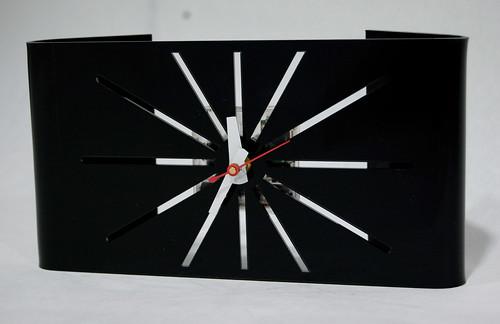
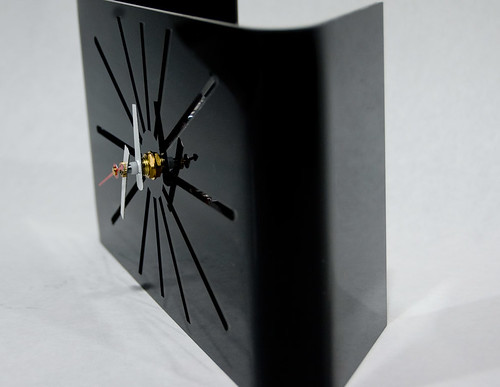
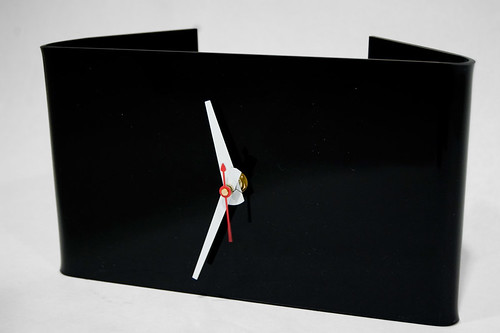
Art Deco Desk Clocks

In Architecture of Objects I just finished up with a quick clock project. I really enjoyed the project, quick but the clock is such a classic design brief. I had sketched for a few days and because of time constraints started to build my original design the day before it was due. Of course, in making physical models, all the issues come out and I scrapped the idea at about 6pm and started sketching again.

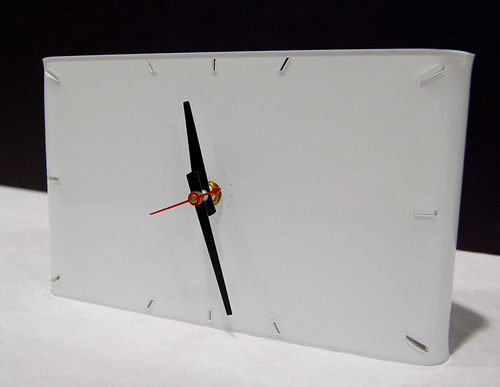
My inspiration for this clock was actually from the video game, BioShock. I had recently being playing the game and was inspired by the immersive art deco environment and decided to pursue a simple clock which would try to bring the styling of the 1920's into modern materials.
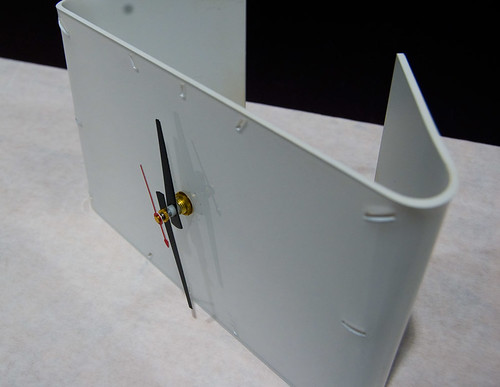
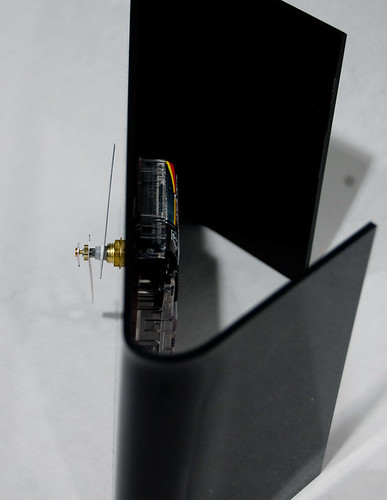
I decided on using clear acrylic which would be laser cut, painted and then heat bent into shape. It was quick, easy and repeatable, which was good since the clocks were due the next morning.

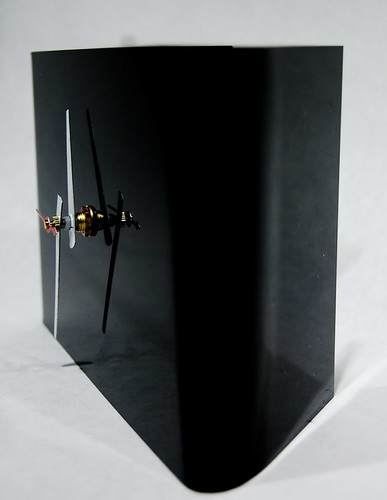
I have three designs in three colors (gloss white, gloss black and matte black).


My favorite of the three is the white clock with the hour markers on the perimeter of the face. Currently, I'm experimenting with the same design in black. The sunburst design, while calling up the art deco influence, exposes the mechanics behind the clock. I'm trying different things with the design to make the mechanics less visible including moving the sunburst starting point out and making the cutouts thinner. We'll see.

The clocks went over well in crit, Shaun felt I had succeeded in styling my clocks after the 1920's and art deco and actually said he would like the white design on his mantle. I consider this to be the ultimate compliment.

Again, for this class I am trying to make products that could be mass produced. With a jig to get the bends correct every time this design would be quite easy to produce on large quantities. I've actually been kicking around the idea of making some more of these and selling them on Esty. We'll see what comes out of it.

Thanks for reading.

Thursday, February 18, 2010

Finished Ikabana Vase

Last Thursday we finished up our Ikabana vases and had our crit. I'll get to the crit in a second, first a bit on my vase and how it was made.

The vase is made of Quickrete exterior anchoring concrete wrapped with aluminum. The concrete was cast in a mold made from mdf. The casting was the biggest headache of the process, mainly because of poor molds made by yours truly. I originally also used Rockite instead of Quickrete. I switched because I wanted the waterproofing that exterior concrete that could be used below the water line would afford and the roughness of the Quickrete versus Rockite's smoothness as a contrast to the precision of the aluminum.

Rockite and mold headaches early on.

The Quickrete in the new improved mold which didn't break part on me. I also wised up on the concrete breaking and soldered together a supporting skeleton using welding wire, mini rebar basically.

The Quickrete vase after coming out of the mold, being sanded to fit the aluminum wrap and being sprayed with a polyethylene gloss. The dark sections on the interior of the vase are leftovers from previous molds attempted with cement colors added. I didn't use the colors (I was using a charcoal) because they pushed the curing time of the Quickrete out to 24 hours instead of 1 hour. It was a result of the process and not planned, but the coloration on the concrete was welcome as it gave the vase a weathered look.

The aluminum being water jet cut in the Digital Fab. Lab.

Aluminum wrap, pre bending. It was bent using the brake in the cold metals shop.

And, the final result with flower arrangement in crit.


So, how did the crit go? It was rough. The worse part about rough crits are when you aren't expecting a rough crit before you show your piece.

The biggest issue was that I wanted to contrast the precision and reflectiveness of the aluminum wrap and support structure against the dark roughness and uneven qualities of the concrete. The issue became that when contrasting precision against rough you have to push precision to its most precise and roughness to its most rough. I felt the aluminum was precise enough considering that I unfortunately had to hand bend the lower tabs holding the concrete and that the concrete it self was visibly chipped, porous and rough but this is a grad level course and ultimately my level of precision and roughness was not up to the class standards.

Also, the aluminum more than dominated the vase, especially when filled with flowers. This was actually a very real problem and looking back on the vase now I feel like it was really the root of all the problems with my vase. With more concrete in view the roughness would be stronger and take all of the emphasis off the precision and allow a more well rounded viewing of the vase.

A lesser bone that they had to pick was the gloss on the concrete made it to finished if I wanted to portray roughness. Jeeze, I want it to be rough but not so rough that it would look out of place in a home so I really didn't know what to make of this one. Since only a few people held this opinion I think I'm chalking that one up to personal opinion and architects who are destined to become professors instead of practicing architects.

My flower arrangement was also a problem for my classmates. It was not dramatic and voluminous enough to work with such a strong, grounded (read heavy) vase. I completely agree on this account and I really didn't care about this issue. I have never arranged flowers before and it was incredibly challenging. Shaun Jackson acknowledged that the whole class had issues with arrangement, but I really feel like he was expecting gold from us on the flower front. All I know is, I'll design the vase, someone else can put the flowers in it.

Really the only good thing anyone had to say about my vase was that they liked the way it was presented with the flowers dominating the foreground of the table and not pushed to the background and the flowers being off center in the vase. A few people also mentioned to me later that they felt some people were being to nitpicky in criticizing my choice of gloss and the concrete not being rough enough. This was nice to hear, but frustrating because they had failed to speak up during the crit.

So, how can I make this a better vase? Well, number one would be adding long thing rectangular windows of sorts to the long aluminum dominated sides to bring the dark concrete through. I really feel this would solve allot of the vase's problems. Also, there was one corner where the aluminum was not completely flush against the concrete, this has to be rectified on the next model with more careful assembly of the vase and the aluminum.

One of the biggest issues for me as a designer over all that has come out during this project (and this intensive class in general) is that I need to get better at speaking about my work. I've taken classes dedicated to the language of design so attempting to put my designs into words is not as much an issue for me. The issue lies in vocalizing my designs during the crit itself. I think this really is an issue of pubic speaking, something which I am not particularly afraid of when I have practiced what I am going to say. There in lies the issue, I am not in the habit of preparing what I am going to say before a crit beyond a few words. Therefore I end up stumbling through my ideas and not effectively portraying them. So, practice, practice, practice.

On a fun note, my vase is now on display outside of the Media Union here. It looks pretty good in a little nook Shaun Jackson found for it. Little win!

Thanks for reading.
Tuesday, February 9, 2010

Ikabana Vase Sketch Models

Just a few of the sketch models I've made in deciding what design to pursue for my final piece. The models are made out of foam core and chip board which is laser cut and then either glued or pinned together.

In these models, the foam core represents the reservoir of the vase and will be made out of Rockite and the chipboard represents stainless steel which will be water jet cut and bent into shape around the Rockite.

Iterations of two designs I'm working with.

The first design is a tall reservoir with a stainless piece of steel straddling the Rockite. I wanted to create a strong, grounded receptacle rising out of a light, kinetic form drawing the eye upward to focus on the flowers using the vase as a way to focus the viewer on the natural beauty of the arrangement. The tab of the stainless steel on the top of the vase would act as a divider between the heavier plant material and the more delicate flowers and would reinforce the upward motion of the vase.

This design will be 8" tall, with a 3" x 2" reservoir.

The only difference between these two iterations is that the model on the left has a shorter piece of chipboard which creates a smaller foot at the bottom with a straighter line as it travels up the Rockite.

This is the other of the two designs I've been working on. This is a much more rectangular, low to the ground vase. I wanted to be able to spread the flowers of the arrangement out horizontally and create some arcs with the plant material. This is a much more static vase, sitting only 1/2" off the table surface and with a horizontal rather than vertical flow of the lines.
The bottom of the two, short feet support the vase and two longer tabs support the base of the Rockite reservoir. This design really focuses the attention of the vase on the stainless steel as it wraps the Rockite almost completely. The Rockite is viewable from two 1/2" strips along the top of the vase and on the small ends of the vase. I wanted the Rockite to simply peak out from the steel.

I prefer the skinnier of the two low vases. It would be only 2 1/2" wide versus 4" wide for the larger version. I felt the increased size of the larger version would create to large and cumbersome of a base for the delicate natural plant material. The final piece will be 8" long x 3" tall x 2 1/2" wide, with a 2" deep reservoir.

I've decided to move forward with the low, horizontal Ikabana vase as I appreciate it's simplicity of form and simplicity of materials in manufacturing. A theme for me in this class has been designing for ease of mass production and I hope to produce these vases on a larger scale if possible after this semester is done. The simpler form and straight lines of this vase lend themselves to reproduction. While there is always value in the one off hand made object, the challenge of reproduction on a large scale interests me as a designer looking to soon move into the work force.

This week I will be milling a mold out of MDF to cast the Rockite in and water jet cutting out my stainless steel piece.

Thanks for reading!

Monday, February 8, 2010

Finished Wall Lamp

Alright, late on an update about past projects again. At least this project wrapped up only a few weeks ago!


I finished up and presented my wall lamp 2 weeks ago now. It went over pretty well, a few concerns about the visibility of the bulb when viewed from a sharp angle from the wall, such as walking down a hallway; a concern of which I agree. Also a problem for some people was the brass grommets I used to attach the tyvek paper to the frame. This was honestly less of an issue for me, but stainless grommets would work just as well. The brass simply dosen't bother me as much as it did some people.


I made a wall lamp because wall lamps save valuable floor space in small apartments and make spaces feel bigger by illuminating the walls. I wanted to create a small shade that would float off the wall, creating an aura of light on the backing wall. Ideally the lamp would be accompanied by multiples along the wall, illuminating an entire wall of the space.


The frame was made of 1/16" and 1/8" steel welding wire which was bent to shape and then the pieces soldered together.

The frame was then sandblasted and spray painted gloss black.


The tyvek paper was folded around the frame and held by brass grommets.


This is the final result.


Overall, I'm honestly quite happy with the lamp. I feel that it would be a design that would be easy to produce in larger quantities and the paper diffuser would be customizable in color and pattern. I'm thinking about making some for gifts for family and friends over this year.


Thanks for reading!
Related Posts with Thumbnails